全膝關節置換術病人於術中使用含抗生素之骨水泥是否能降低術後深部感染率?
一、背景
全膝關節置換術之術後深部感染是病人術後極具傷害性的合併症之ㄧ(Srivastav, Nadkarni, Srivastav, Mittal, & Agarwal, 2009 ),病人常因術後深部感染而需要反覆進行多次手術及接受更多的抗生素治療。臨床上全膝關節置換術過程中部份醫師會在骨水泥內加入抗生素,以期降低術後深部感染率,然其成效如何,實需要實證資料佐證。
二、目的
本文期望藉由實證方法探討全膝關節置換術中使用含抗生素的骨水泥是否能降低術後深部感染率,據此提供臨床照護之最佳實證建議。
二、方法
以實證方法搜尋Cochrane library、CINAHL、PudMed/ Medline、Clinical evidence、CEPS、台灣期刊論文索引系統等六個資料庫,輸入【(「total knee replacement」OR「total knee arthroplasty」)AND(「impregnated cement」OR「antibiotic-loaded bone cement」)AND(「infection」OR「deep infection rate」)】等關鍵字,共獲得179篇相關文獻,限制條件為非比較性研究設計,排除重複、不符合研究目的等文獻,最終採納五篇文獻進行詳細評讀,如下圖一。
| 步驟一:提出PICO P : 全膝關節置換術之成年病人、Total knee replacement、Total knee arthroplasty、Adult I : 含抗生素骨水泥、Antibiotic-loaded bone cement C : 一般骨水泥、Bone cement、Impregnated cement O : 術後深部感染率、Deep infection、Infection rate Study: Meta-analysis, systematic review, RCT, cohort study, case-control study |

| 步驟二:系統性的搜尋文獻(鍵入如上述之key words與限制條件) Cochrane Library:3篇;Clinical evidence:0篇;PudMed/ Medline:5篇;CINAHL:3篇;CEPS:0篇;台灣期刊論文索引系統:0篇。扣除重覆,總共評讀5篇。 |
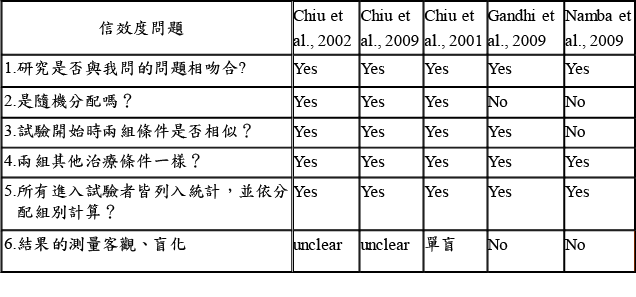
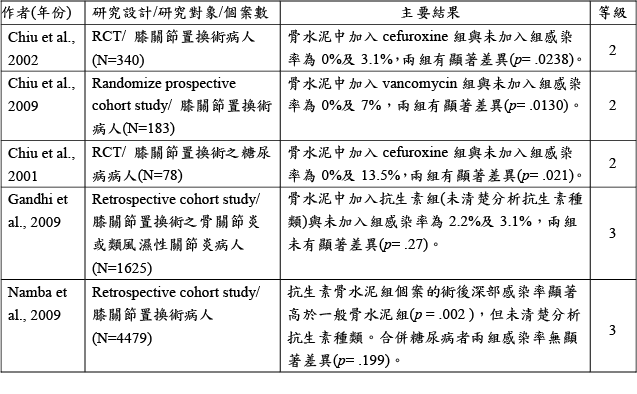
步驟三:評讀文獻(詳閱下表一與表二) 以Oxford Centre for Evidence-based Medicine (2011)之證據等級評讀文獻等級,結果為Level 2三篇與Level 3二篇。 |
步驟四:整合現有最佳證據並做臨床照護決策 全膝關節置換過程中,可以考慮在骨水泥中加入Cefuroxine或Vancomycin抗生素,以期預防術後深部感染。 |
圖一 實證方法的步驟過程
表一 文獻研究信效度評讀
表二 文獻研究結果評讀
三、結果
五篇研究報告中,二篇Level 2的個別性隨機控制試驗研究(Chiu, Chen, Lin, & Lo, 2002; Chiu, Lin, Chen, Lo, & Chaung, 2001)指出Cefuroxine骨水泥組個案的術後深部感染率顯著低於一般骨水泥組(p = .0238與p = .021);一篇Level 2的前瞻性隨機世代研究(Chiu & Lin, 2009),顯示Vancomycin骨水泥組個案的術後深部感染率顯著低於一般骨水泥組(p = .0130)。但另外兩篇Level 3的回溯性世代研究(Gandhi et al., 2009; Namba, Chen, Paxton, Slipchenko, & Fithian, 2009),卻未有明顯成效,亦未清楚分析加入骨水泥的抗生素種類,其中一篇研究的兩組個案基本屬性亦不同質。
四、結論
依據現有最佳證據指出Cefuroxine與Vancomycin骨水泥可顯著降低術後深部感染的發生率。一次全膝關節置換術若使用Cefuroxine或Vancomycin,所需成本約健保費123~608元/次。若以深部感染率而言,可以預防病人發生術後深部感染的發生率,避免潛在增加手術次數、增加抗生素使用量、延長住院天數、耗用醫護照護人力,且可增進病人安全。
據此建議全膝關節置換過程中,針對感染高危險群個案,可以在骨水泥中加入Cefuroxine或Vancomycin抗生素,以期預防術後深部感染。
五、參考資料
Chiu, F. Y., Chen, C. M., Lin, C. F., & Lo, W. H. (2002). Cefuroxime-impregnated cement in primary total knee arthroplasty: A prospective, randomized study of three hundred and forty knees. The Journal of Bone & Joint Surgery, 84(5), 759-762.
Chiu, F. Y., & Lin, C. F. (2009). Antibiotic-impregnated cement in revision total knee arthroplasty. A prospective cohort study of one hundred and eighty-three knees. The Journal of Bone & Joint Surgery, 91(3), 628-633.
Chiu, F. Y., Lin, C. F., Chen, C. M., Lo, W. H., & Chaung, T. Y. (2001). Cefuroxime-impregnated cement at primary total knee arthroplasty in diabetes mellitus. A prospective, randomised study. The Journal of Bone & Joint Surgery, 83(5), 691-695.
Gandhi, R., Razak, F., Pathy, R., Davey, J. R., Syed, K., & Mahomed, N. N. (2009). Antibiotic bone cement and the incidence of deep infection after total knee arthroplasty. The Journal of Arthroplasty, 24(7), 1015-8.
Namba, R. S., Chen, Y., Paxton, E. W., Slipchenko, T., & Fithian, D. C. (2009). Outcomes of routine use of antibiotic-loaded cement in primary total knee arthroplasty. The Journal of Arthroplasty, 24(6), 44-47.
Srivastav, A. K., Nadkarni, B., Srivastav, S., Mittal, V., & Agarwal, S. (2009). Prophylactic use of antibiotic-loaded bone cement in primary total knee arthroplasty: Justified or not? Indian Journal of Orthopaedics, 4(3), 259-263.